
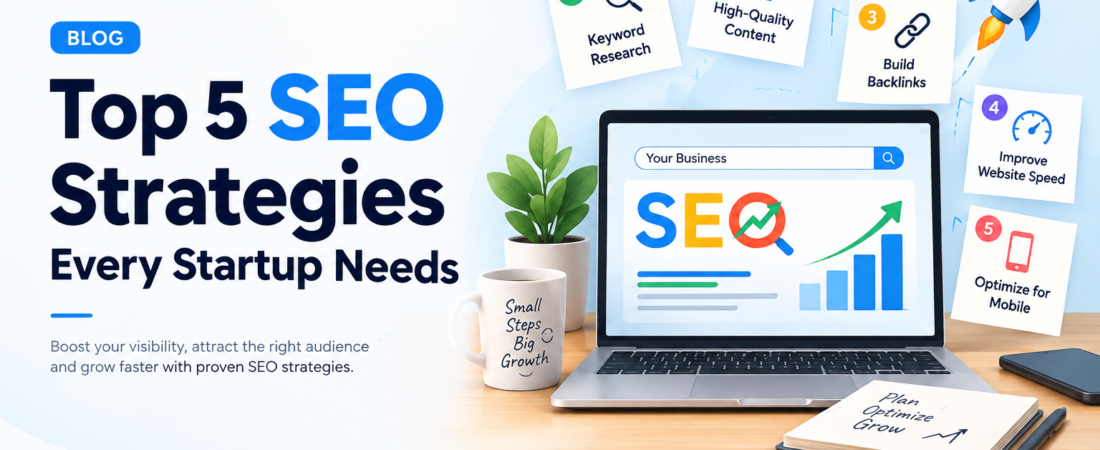
1. Conduct Smart Keyword Research
Keyword research is the foundation of an effective SEO strategy. Before creating website pages or blog posts, startups need to understand what their target audience is actually searching for.
Instead of choosing keywords based only on high search volume, focus on keywords that match your products, services, audience, and business goals.
For example, a startup offering digital marketing services could target keywords such as:
- Digital marketing agency
- SEO services for startups
- Digital marketing services for startups
- SEO agency for small businesses
- Google Ads services
- Social media marketing services
- Website development services
Focus on Long-Tail Keywords
Long-tail keywords are more specific search phrases, usually containing several words. They often have lower competition and can attract visitors with a clearer search intent.
For example, instead of targeting only “SEO”, a startup could target “SEO services for startups in Pune.”
Long-tail keywords can help new businesses target more specific audiences and create content around specific customer problems.
Understand Search Intent
Search intent refers to the reason behind a user’s search.
Common types include:
- Informational: The user wants information.
- Navigational: The user wants to find a specific website or brand.
- Commercial: The user is researching products or services.
- Transactional: The user is ready to take an action or make a purchase.
Understanding search intent allows startups to create content that actually satisfies what users are looking for.
2. Optimize Your Website for On-Page SEO
Once you identify the right keywords, the next step is optimizing your website pages.
On-page SEO involves improving elements that appear directly on your website, including content, headings, titles, URLs, images, and internal links.
Optimize SEO Titles
Your SEO title tells both search engines and users what your page is about.
For example:
Weak:
“Home | Company Name”
Better:
“Digital Marketing Services for Startups | Promotive”
Your primary keyword should appear naturally in the title when appropriate.
Write Effective Meta Descriptions
A meta description provides a short summary of a webpage. While it is not simply a ranking-factor shortcut, a well-written description can encourage users to click your result.
Keep it clear, relevant, and focused on the value your page provides.
Use Proper Heading Structure
Organize your content with headings such as:
- H1 for the main page title
- H2 for major sections
- H3 for supporting subsections
This makes your content easier for visitors to read and helps search engines understand the structure of your page.
Optimize URLs
Keep URLs short, descriptive, and relevant.
For example:
Better:yourwebsite.com/seo-strategies-startups/
Avoid unnecessarily long URLs containing random numbers or unrelated words.
Add Internal Links
Internal links connect one page on your website to another.
For example, a blog about SEO could link naturally to your:
- SEO services page
- Digital marketing services page
- Website development page
- Contact page
- Related blog posts
Internal linking helps visitors discover more content and helps search engines understand relationships between pages on your website.
3. Create High-Quality, Helpful Content
Content marketing and SEO work closely together. Startups should consistently publish useful content that answers questions, solves problems, and demonstrates expertise.
Instead of writing articles simply to insert keywords, create content for real users.
Build Topic Clusters
Rather than publishing unrelated articles, organize your content around important topics.
For example, a startup offering digital marketing services could create a main topic around SEO for businesses and supporting articles such as:
- SEO basics for startups
- How to conduct keyword research
- Common SEO mistakes
- Local SEO strategies
- Technical SEO checklist
- SEO content writing tips
These related articles can be internally linked to create a stronger content structure.
Answer Customer Questions
Your customers are likely searching for answers before contacting your business.
Turn frequently asked questions into useful blog posts.
For example:
- How much does SEO cost for a startup?
- How long does SEO take to show results?
- Why is my website not ranking on Google?
- How can a startup increase organic traffic?
- What are the most important SEO ranking factors?
This approach can help your website attract visitors at different stages of the buying journey.
Prioritize Quality Over Quantity
Publishing dozens of low-quality articles is not a sustainable SEO strategy.
Focus on content that is:
- Original
- Accurate
- Useful
- Easy to understand
- Well structured
- Relevant to your audience
- Regularly reviewed and updated
4. Invest in Technical SEO and Website Performance
Great content cannot perform well if search engines or users struggle to access your website.
Technical SEO focuses on improving the technical foundation of your site so that search engines can crawl and understand it effectively.
Improve Website Speed
Slow websites can create a poor user experience. Startups should optimize images, reduce unnecessary scripts, use reliable hosting, and follow good website performance practices.
Make Your Website Mobile-Friendly
A large portion of internet users browse websites through smartphones. Your website should work properly across desktops, tablets, and mobile devices.
Check that:
- Text is easy to read
- Buttons are easy to tap
- Menus work correctly
- Images fit the screen
- Forms are simple to complete
Create an XML Sitemap
An XML sitemap helps search engines discover important URLs on your website. Make sure your sitemap is properly generated and submitted through the appropriate search engine tools.
Fix Broken Links
Broken links can negatively affect user experience and make website maintenance more difficult.
Regularly check your website for:
- Broken internal links
- Incorrect redirects
- Missing pages
- 404 errors
- Duplicate or problematic URLs
Use HTTPS
Your startup website should use HTTPS to provide a secure connection between visitors and your website.
Technical SEO may not always be visible to customers, but it forms an important part of a healthy website.
5. Build Local SEO and High-Quality Backlinks
For many startups, especially those serving a specific city or region, local SEO can be highly valuable.
If your business serves customers in Pune, for example, optimizing your online presence for relevant local searches can help you reach people searching for services in that area.
Optimize Your Google Business Profile
Create and maintain an accurate Google Business Profile with:
- Correct business name
- Address or service area
- Phone number
- Website
- Business category
- Working hours
- Photos
- Services
- Customer reviews
Keep your information consistent across important online platforms.
Encourage Genuine Customer Reviews
Positive and authentic customer reviews can provide useful information to potential customers and contribute to your local online presence.
Always encourage genuine feedback rather than using misleading or artificial reviews.
Earn Quality Backlinks
Backlinks are links from other websites to your website. Search engines can use links as signals when evaluating pages, although not every backlink has the same value.
Startups should focus on earning relevant, trustworthy links through:
- Industry publications
- Business directories
- Guest contributions
- Digital PR
- Partnerships
- Original research
- Useful resources
- Shareable content
Avoid buying large quantities of low-quality links or participating in manipulative link schemes. A smaller number of relevant, trustworthy links can be more useful than a large collection of poor-quality links.
How to Measure Your Startup SEO Performance
SEO requires continuous monitoring. Startups should track meaningful metrics instead of focusing only on rankings.
Important SEO metrics include:
- Organic traffic
- Search impressions
- Click-through rate
- Keyword visibility
- Organic conversions
- Leads generated
- Engagement metrics
- Indexed pages
- Backlinks
- Core website performance indicators
Tools such as Google Search Console and Google Analytics can help businesses understand how visitors discover and interact with their websites.
The goal should not simply be to rank for keywords. Your SEO strategy should ultimately support meaningful business outcomes such as leads, enquiries, sales, or sign-ups.
Common SEO Mistakes Startups Should Avoid
While implementing SEO, startups should avoid common mistakes such as:
Keyword Stuffing
Repeating the same keyword excessively can make content unnatural and difficult to read.
Ignoring Search Intent
A page may target a popular keyword but still fail to satisfy what users actually want.
Publishing Thin Content
Short or shallow content that provides little value is unlikely to build strong organic visibility.
Neglecting Mobile Users
A website that works poorly on smartphones can lose potential customers.
Buying Low-Quality Backlinks
Manipulative link-building practices can create long-term SEO problems.
Expecting Instant Results
SEO generally requires time, testing, content development, technical improvements, and consistent effor