
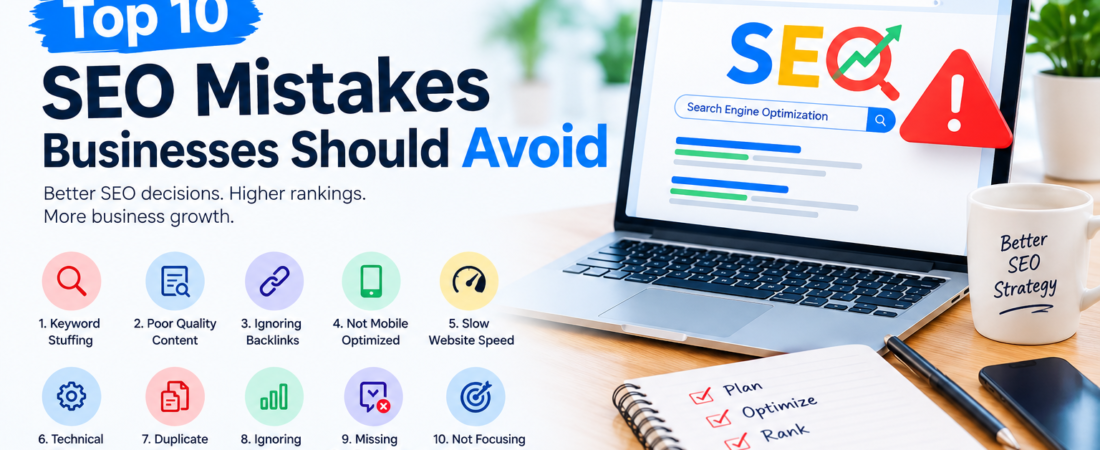
1. Keyword Stuffing
One of the most common SEO mistakes businesses make is keyword stuffing.
Keyword stuffing means using the same keyword excessively throughout a webpage in an attempt to rank higher in search results. For example, repeatedly using phrases such as “digital marketing agency” in every sentence can make content unnatural and difficult to read.
Search engines are increasingly focused on helpful, relevant content rather than excessive keyword repetition.
How to avoid it:
- Use keywords naturally
- Include related terms and variations
- Focus on answering the user’s search intent
- Avoid repeating the same keyword unnecessarily
- Write primarily for people, not search engines
Your primary keyword should appear naturally in important areas such as the title, introduction, headings, URL, and relevant sections.
2. Ignoring Search Intent
Another major SEO mistake is creating content without understanding search intent.
Search intent refers to the reason behind a user’s search. Someone searching for “what is SEO” has a different intention from someone searching for “SEO agency near me.”
Common search intents include:
- Informational: Looking for information
- Navigational: Looking for a particular website or brand
- Commercial: Researching products or services
- Transactional: Ready to make a purchase or take action
If your content does not match the user’s intent, visitors may leave your website quickly.
How to avoid it:
Before creating content, understand what users expect when they search for your target keyword. Then create content that directly addresses their questions, needs, or problems.
3. Publishing Low-Quality or Thin Content
Publishing large amounts of low-quality content does not guarantee better rankings.
Some businesses create short articles that provide little useful information simply because they want to publish frequently. This can result in poor user engagement and limited organic visibility.
Instead of focusing only on publishing volume, concentrate on content quality and usefulness.
High-quality content should:
- Provide accurate information
- Answer the user’s questions
- Be easy to read
- Include useful examples
- Use clear headings and formatting
- Offer practical solutions
- Be updated when information changes
A detailed and genuinely useful article can provide more value than multiple low-quality posts.
4. Neglecting On-Page SEO
On-page SEO involves optimizing elements on individual webpages to help search engines understand their content.
Businesses sometimes publish content without optimizing important page elements such as titles, headings, URLs, and meta descriptions.
Important on-page SEO elements include:
- SEO title
- Meta description
- H1 heading
- H2 and H3 subheadings
- URL structure
- Internal links
- Image alt text
- Keyword placement
- Content structure
For WordPress websites, tools such as Rank Math SEO can make it easier to monitor and optimize many of these elements.
However, SEO plugins should be used as optimization guides rather than as a replacement for a well-planned SEO strategy.
5. Using Poor Website URLs
Website URLs are often overlooked, but they can contribute to a website’s usability and SEO structure.
A complicated URL containing unnecessary numbers, symbols, or unrelated words can be difficult for users and search engines to understand.
For example:
Poor URL:
example.com/page?id=12345
Better URL:
example.com/seo-mistakes-businesses-should-avoid/
A good URL should be:
- Short and descriptive
- Easy to read
- Relevant to the page
- Focused on the main topic
- Free from unnecessary parameters when possible
A clean URL structure also makes your website easier to navigate and manage.
6. Ignoring Mobile Optimization
A large percentage of website visitors access websites using smartphones and tablets. If your website does not work properly on mobile devices, you may lose potential customers.
Mobile SEO is not simply about making text smaller. Your entire website should provide a smooth experience across different screen sizes.
Check whether:
- Text is easy to read
- Buttons are easy to tap
- Images display correctly
- Navigation works properly
- Pages load efficiently
- Forms work on mobile devices
- Content fits the screen without unnecessary horizontal scrolling
A responsive website can provide a better experience for visitors using smartphones and tablets.
7. Having a Slow Website
Website speed is another important factor businesses should not ignore.
Visitors generally expect websites to load quickly. Slow pages can create a poor user experience and may contribute to visitors leaving before interacting with your content.
Common reasons for slow websites include:
- Large image files
- Too many plugins
- Poor hosting performance
- Unoptimized code
- Excessive scripts
- Unnecessary website features
How to improve website performance:
- Compress and optimize images
- Use modern image formats where appropriate
- Remove unnecessary plugins
- Use caching
- Optimize website code
- Choose suitable hosting
- Monitor Core Web Vitals and page performance
Website performance should be monitored regularly rather than optimized only once.
8. Ignoring Internal Linking
Internal links connect one page of your website to another page on the same website.
For example, a blog about SEO mistakes could link to related content about SEO services, content marketing, or digital marketing strategies.
Internal linking can help:
- Users discover related content
- Search engines understand website structure
- Distribute internal authority between pages
- Improve website navigation
- Encourage visitors to explore more pages
When adding internal links, use descriptive anchor text that tells users what they can expect after clicking.
Avoid adding internal links simply for the sake of increasing the number of links. Every link should provide value to the visitor.
9. Forgetting Image SEO
Images can improve the visual appeal and usefulness of a webpage, but businesses often overlook image optimization.
Uploading huge, unoptimized images can slow down your website. At the same time, missing or unclear alternative text can make images less accessible.
For better image SEO:
- Compress images before uploading
- Use descriptive file names
- Add appropriate alt text
- Choose suitable image dimensions
- Use modern image formats when appropriate
- Avoid unnecessarily large images
For example, instead of naming an image:
IMG12345.jpg
use a descriptive filename such as:
digital-marketing-agency-seo-strategy.jpg
Image optimization should balance SEO, accessibility, website speed, and visual quality.
10. Expecting Instant SEO Results
Perhaps one of the biggest mistakes businesses make is expecting SEO results immediately.
SEO is generally a long-term marketing strategy. Rankings can change because of competition, search trends, website changes, content quality, technical issues, and many other factors.
Businesses should avoid judging their SEO strategy based on a few days or weeks of performance alone.
Instead, monitor meaningful metrics over time, such as:
- Organic traffic
- Search impressions
- Keyword rankings
- Click-through rate
- Organic conversions
- Leads generated
- Engagement metrics
- Indexed pages
Regular monitoring helps identify what is working and where improvements are require