
1. Artificial Intelligence in Digital Marketing
Artificial Intelligence (AI) has become one of the most important trends in digital marketing. Enterprises are increasingly using AI to analyze large amounts of customer data, automate repetitive tasks, create content, and improve customer experiences.
AI can help marketing teams identify customer behavior patterns, generate content ideas, analyze campaigns, personalize communication, and automate parts of the customer journey.
For enterprises, AI can be particularly valuable because large organizations often have huge amounts of marketing and customer data.
How enterprises can use AI:
- Generate content ideas and outlines
- Analyze customer behavior
- Automate marketing workflows
- Improve customer segmentation
- Personalize marketing campaigns
- Analyze advertising performance
- Support customer service through AI-powered chatbots
The key is to use AI as a productivity and decision-support tool while maintaining human oversight, brand consistency, accuracy, and originality. Digital Marketing Trends For Enterprises
2. SEO for Search Engines and AI Search
Search behavior is changing. Customers are no longer relying only on traditional search results. They may also use AI-powered search experiences to discover information, products, and businesses.
Digital Marketing Trends For Enterprises
This makes SEO for enterprises increasingly important.
Enterprise SEO involves optimizing thousands of pages, managing technical SEO, improving website architecture, creating useful content, and maintaining consistent optimization across multiple products or locations.Digital Marketing Trends For Enterprises
Enterprises should focus on:
- Search intent
- Helpful and original content
- Technical SEO
- Website speed and performance
- Structured data
- Internal linking
- Topic authority
- Mobile usability
- Strong user experience
Instead of creating content only around keywords, enterprises should build comprehensive resources that genuinely answer customers’ questions.
3. Personalized Customer Experiences
Customers expect brands to understand their interests and provide relevant experiences. Personalization has therefore become an important part of enterprise digital marketing.
Enterprises can use customer data and marketing platforms to create more relevant experiences across websites, email campaigns, advertisements, and other digital channels.
For example, an enterprise can personalize marketing communication based on:
- Previous purchases
- Website behavior
- Customer interests
- Geographic location
- Industry
- Stage in the buying journey
Effective personalization can make marketing communication more relevant and help businesses build stronger relationships with their audiences.
However, enterprises should always handle customer data responsibly and follow applicable privacy and data-protection requirements.
4. Short-Form and Video Marketing
Video continues to be an important content format for digital marketing. Short-form videos are particularly useful for capturing attention on social media and communicating information quickly.
Enterprises can use video marketing to explain products, demonstrate services, educate customers, share company stories, and showcase expertise.
Popular enterprise video content ideas include:
- Product demonstrations
- Customer testimonials
- Educational videos
- Behind-the-scenes content
- Industry insights
- Expert interviews
- Product comparisons
- Frequently asked questions
Video content can also support SEO when it is published alongside useful written content and properly optimized.
A strong enterprise video strategy should focus on providing value rather than simply producing a large volume of videos.Digital Marketing Trends For Enterprises
5. Data-Driven Marketing and Analytics
Modern enterprises generate enormous amounts of data. The challenge is turning that data into useful marketing decisions.
Data-driven digital marketing allows organizations to understand which channels, campaigns, audiences, and content are producing meaningful results.
Important metrics may include:
- Website traffic
- Conversion rate
- Cost per lead
- Customer acquisition cost
- Return on advertising spend
- Engagement rate
- Lead quality
- Customer lifetime value
Instead of focusing only on impressions or clicks, enterprises should connect marketing data with meaningful business outcomes.
A strong analytics strategy helps marketing teams understand what is working, identify opportunities, and allocate resources more effectively.Digital Marketing Trends For Enterprises
6. Omnichannel Marketing
Customers interact with enterprises through multiple channels. They may discover a brand through Google, visit its website, watch a social media video, receive an email, and later interact with a sales representative.
Omnichannel marketing aims to create a consistent customer experience across these touchpoints.
Enterprise marketing teams should coordinate channels such as:
- Google Search
- Social media
- Websites
- Mobile applications
- Paid advertising
- Content marketing
- Offline sales channels
The goal is not simply to be present everywhere. The important part is creating a connected experience where each channel supports the overall customer journey.
7. Social Media Marketing for Brand Building
Social media remains an important channel for enterprises to communicate with customers and strengthen brand awareness.
Large organizations can use platforms such as LinkedIn, Instagram, Facebook, YouTube, and other relevant channels depending on their audience.
Enterprise social media strategies can include:
- Educational content
- Industry updates
- Product announcements
- Employee stories
- Customer success stories
- Short-form videos
- Thought leadership
- Community engagement
Enterprises should avoid treating every social platform in exactly the same way. Each platform has different audiences, content formats, and user expectations.
A well-planned social media strategy should connect organic content with broader brand and business objectives.Digital Marketing Trends For Enterprises
8. Marketing Automation
Enterprise marketing often involves thousands or millions of potential customers. Manually managing every interaction is difficult and inefficient.
Marketing automation can help enterprises automate repetitive marketing activities and create structured customer journeys.
Automation can be used for:
- Email campaigns
- Lead nurturing
- Customer segmentation
- Follow-up communication
- Campaign workflows
- Lead scoring
- Customer onboarding
- Re-engagement campaigns
For example, when a potential customer downloads a valuable resource, an automated workflow can deliver relevant follow-up content based on the customer’s interests.
Automation allows marketing teams to spend more time on strategy, creativity, and optimization instead of repetitive tasks.
9. First-Party Data and Privacy-Focused Marketing
Privacy has become an increasingly important consideration for digital marketers. Enterprises need to understand how customer information is collected, stored, processed, and used.
First-party data refers to information collected directly through a company’s own customer interactions and digital properties, subject to applicable consent and privacy requirements.
Examples include:
- Website interactions
- Customer purchases
- Account information
- Email subscriptions
- Customer feedback
- Direct interactions with the company
Enterprises should develop transparent data practices and provide customers with clear information about how their data is used.
Building trust around customer data can become an important part of a long-term digital marketing strategy.
10. Content Marketing Focused on Expertise and Value
Content marketing remains an important strategy for enterprises, but simply publishing large quantities of content is not enough.
Customers want useful, accurate, relevant, and trustworthy information.
Enterprises should create content that demonstrates genuine expertise and addresses customer problems throughout the buying journey.
Useful enterprise content can include:
- Detailed blog posts
- Industry reports
- Case studies
- Whitepapers
- Research-based articles
- Product guides
- Tutorials
- Comparison pages
- Frequently asked questions
A strong content marketing strategy should connect content with specific business objectives such as brand awareness, lead generation, customer education, or retention.
How Enterprises Can Implement These Digital Marketing Trends
Following every trend is not necessarily the right approach for every enterprise. Businesses should evaluate trends based on their customers, industry, resources, and objectives.
A practical implementation process can include:
Step 1: Understand Your Audience
Research your target customers, their challenges, search behavior, preferred platforms, and purchasing journey.
Step 2: Audit Your Existing Digital Strategy
Review your SEO, website, paid advertising, social media, content, email marketing, and analytics.
Step 3: Identify Opportunities
Determine which trends can address your biggest marketing challenges.
Step 4: Test New Strategies
Start with controlled campaigns or pilot projects rather than making large-scale changes immediately. top 10 Digital Marketing Trends
Step 5: Measure Results
Use meaningful KPIs to evaluate performance. top 10 Digital Marketing Trends
Step 6: Optimize and Scale
Once a strategy demonstrates value, refine the process and consider expanding it across relevant markets and customer segments.
Why Digital Marketing Matters for Enterprises
Digital marketing provides enterprises with multiple ways to connect with customers throughout the buying journey.
A strong digital marketing strategy can help enterprises:
- Increase online visibility
- Generate qualified leads
- Build brand awareness
- Improve customer engagement
- Reach targeted audiences
- Strengthen customer relationships
- Measure marketing performance
- Support business growth top 10 Digital Marketing Trends
However, successful enterprise marketing requires more than adopting the latest trend. Businesses need a clear strategy, strong execution, reliable data, and continuous optimization. top 10 Digital Marketing Trends
Conclusion
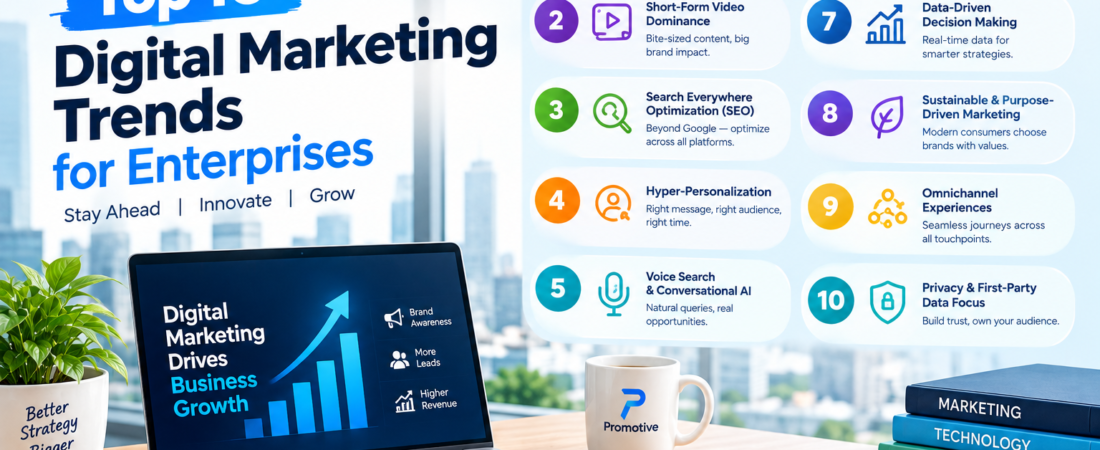
The digital marketing landscape is changing rapidly. AI, enterprise SEO, personalization, video marketing, data analytics, omnichannel strategies, automation, privacy-focused marketing, social media, and valuable content are among the major trends shaping modern enterprise marketing.
For enterprises, the most important objective is not to follow every trend blindly. Instead, businesses should identify the technologies and strategies that align with their customers and business goals.
By combining innovative technology with high-quality content, strong SEO, effective advertising, data analysis, and customer-focused experiences, enterprises can build a sustainable digital marketing strategy for long-term growth.
If your enterprise needs help with SEO, Google Ads, Meta Ads, social media management, website development, or a complete digital marketing strategy, working with an experienced digital marketing agency can help create and execute a strategy based on your specific business objectives.
Artificial Intelligence (AI) has become one of the most important trends in digital marketing. Enterprises are increasingly using AI to analyze large amounts of customer data, automate repetitive tasks, create content, and improve customer experiences.
AI can help marketing teams identify customer behavior patterns, generate content ideas, analyze campaigns, personalize communication, and automate parts of the customer journey.
For enterprises, AI can be particularly valuable because large organizations often have huge amounts of marketing and customer data.
For more details contact us